Table of Contents
Introduction
You do not need a gym membership or expensive equipment to build a strong, lean body. A well-designed calisthenics workout plan for beginners at home uses your own bodyweight as resistance — and it works remarkably well. Calisthenics is one of the oldest and most effective forms of training in the world. Athletes, soldiers, and fitness enthusiasts have relied on bodyweight training for centuries. If you are a beginner looking to start your fitness journey from home, this guide is built for you.
What Is Calisthenics and Why Should Beginners Try It?
Calisthenics is a form of strength training that uses only your body weight — no barbells, dumbbells, or machines required. Push-ups, squats, lunges, pull-ups, and planks are all forms of calisthenics.
Why beginners love calisthenics:
- Zero cost: No gym fees. No equipment purchases. Just your body and a little space.
- Train anywhere: A living room, balcony, park, or hotel room works perfectly.
- Builds functional strength: Trains your muscles to work together, improving everyday movement.
- Reduces injury risk: Bodyweight movements are lower impact than heavy barbell lifting.
- Scalable: Make exercises easier or harder simply by changing your body position.
- Improves flexibility and body control: Builds mobility alongside strength.
Essential Calisthenics Exercises for Beginners
Upper Body
- Push-ups: The foundation of upper body calisthenics. Builds chest, shoulders, and triceps.
- Diamond push-ups: Closer grip for more tricep focus.
- Pike push-ups: Targets the shoulders.
- Plank hold: Builds the entire core and shoulder stability.
Lower Body
- Bodyweight squats: Builds quads, hamstrings, and glutes.
- Lunges: Strengthens legs and improves balance.
- Glute bridges: Isolates the glutes and lower back muscles.
- Wall sit: Builds quad endurance and mental toughness.
Core
- Crunches: Basic core activation.
- Leg raises: Lower ab focused.
- Mountain climbers: Cardio + core combo.
- Superman hold: Strengthens the lower back.
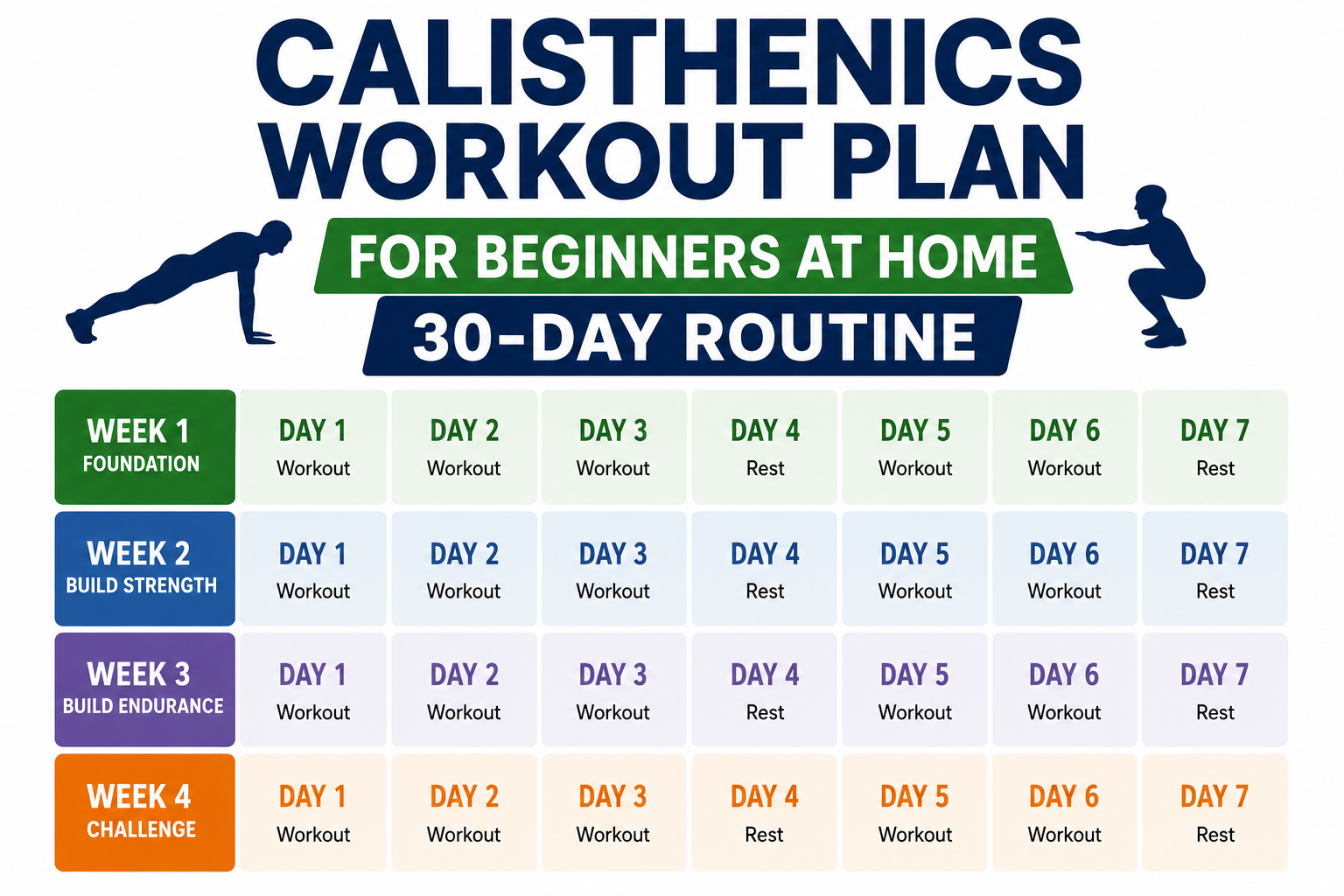
4-Week Calisthenics Workout Plan for Beginners at Home
Week 1 — Foundation Phase (3 Days/Week)
| Day | Workout Focus | Exercises | Sets x Reps |
|---|---|---|---|
| Day 1 | Upper Body | Push-ups, Pike push-ups, Plank | 3 x 8-10 |
| Day 2 | Rest or Walk | Light 20-min walk | — |
| Day 3 | Lower Body | Squats, Lunges, Glute bridges | 3 x 10-12 |
| Day 4 | Rest | — | — |
| Day 5 | Full Body + Core | Burpees, Mountain climbers, Leg raises | 3 x 8 |
| Day 6 | Active rest | Stretching or yoga | — |
| Day 7 | Rest | — | — |
Week 2 — Building Phase (4 Days/Week)
Add one more training day. Increase sets by one.
- Day 1: Push-ups (4×10), Diamond push-ups (3×8), Plank hold (3×30 sec)
- Day 2: Squats (4×12), Lunges (3×10 each leg), Wall sit (3×30 sec)
- Day 3: Rest
- Day 4: Core circuit — Crunches, Leg raises, Superman holds (3 rounds)
- Day 5: Full body — Burpees, Jump squats, Bear crawls (3 rounds)
- Days 6-7: Rest and active recovery
Week 3 — Strength Development (4 Days/Week)
- Upgrade push-ups to decline push-ups (feet elevated on a chair)
- Add single-leg glute bridges
- Try slow-motion squats (5 seconds down, 2 seconds up)
- Introduce jumping lunges for more challenge
Week 4 — Progressive Overload (5 Days/Week)
- Attempt 5 sets instead of 3
- Increase reps by 20-30%
- Add a 5-minute HIIT finisher (burpees + mountain climbers alternating)
- Hold plank for 60+ seconds
Step-by-Step Guide to Starting Your Calisthenics Journey

- Assess your current fitness level — can you do 1 push-up? 5 squats? Start there.
- Create a dedicated workout space — clear a 6×6 foot area. A yoga mat helps.
- Learn the form before adding reps — a perfect push-up beats 20 sloppy ones.
- Warm up every single time — spend 5-7 minutes warming up before every workout.
- Follow the plan — consistency beats intensity. Commit to the plan for 4 weeks.
- Track your progress — keep a simple workout journal with reps and how you felt.
- Prioritise sleep and nutrition — aim for 7-9 hours sleep and 0.8-1.2g protein per kg.
Beginner Calisthenics vs Gym Training: Quick Comparison
| Factor | Calisthenics at Home | Gym Training |
|---|---|---|
| Cost | Free | Rs 500-3,000/month |
| Equipment needed | None | Yes (machines, weights) |
| Injury risk | Lower | Moderate to higher |
| Convenience | Very high (train anytime) | Requires travel |
| Muscle building | Very effective | Very effective |
| Flexibility gains | High | Low to moderate |
| Suitable for beginners | Yes | Yes (with guidance) |
Tips for Success with Calisthenics at Home
- Progressive overload is essential: Regularly make exercises harder — more reps, slower tempo, or harder variations.
- Rest days are not optional: Muscles grow during rest, not during training.
- Breathing matters: Exhale on the effort (pushing phase). Inhale on the release.
- Film yourself occasionally: Best way to catch form errors you cannot feel.
- Do not compare your week 1 to someone else’s week 52.
Common Mistakes Beginners Make in Calisthenics
- Doing too much too soon: Start small and build gradually.
- Skipping the warm-up: Cold muscles are more prone to injury.
- Ignoring lower body training: Balance upper and lower body for overall strength.
- Not eating enough protein: Without protein, muscles cannot rebuild after a workout.
- Expecting overnight results: Visible changes take 6-8 weeks of consistent training.
Frequently Asked Questions (FAQs)
Q1. Is calisthenics effective for building muscle as a beginner?
Absolutely. Beginners see excellent muscle growth with bodyweight training because any new resistance stimulus is enough to trigger adaptation.
Q2. How many days a week should a beginner do calisthenics?
Start with 3 days per week. This gives your body enough time to recover between sessions. You can gradually increase to 4-5 days as fitness improves.
Q3. Can I lose weight with a calisthenics workout plan at home?
Yes. Calisthenics burns calories and builds muscle, which increases your metabolic rate. Combined with a healthy diet, it is effective for fat loss.
Q4. Do I need any equipment to start calisthenics at home?
No. Your bodyweight is all you need to start. As you advance, a pull-up bar (under Rs 500 for a doorframe model) opens up a wider range of exercises.
Q5. How long before I see results from calisthenics?
Most beginners notice improved strength and endurance within 2-3 weeks. Visible changes in muscle tone appear after 6-8 weeks of consistent training.
Q6. Is calisthenics suitable for overweight beginners?
Yes. Start with modified versions — wall push-ups, chair-assisted squats, and short plank holds. Progress to standard variations as strength builds.
Q7. Can a beginner do calisthenics every day?
Not recommended. Muscles need 48 hours to recover after a strength workout. Train 3-5 days per week and use rest days for walking, stretching, or light yoga.
Q8. What should I eat before a calisthenics workout?
Have a small, balanced snack 30-60 minutes before training — such as a banana with peanut butter, or curd with oats. Avoid heavy meals.
Conclusion
A calisthenics workout plan for beginners at home is one of the most accessible, sustainable, and effective ways to start your fitness journey. You do not need a gym, a trainer, or fancy equipment. You just need your body, a small space, and the commitment to show up regularly.
Start your first workout today. Right now, do 10 squats, 5 push-ups, and a 20-second plank. That is your beginning. Everything great starts with a single rep.

