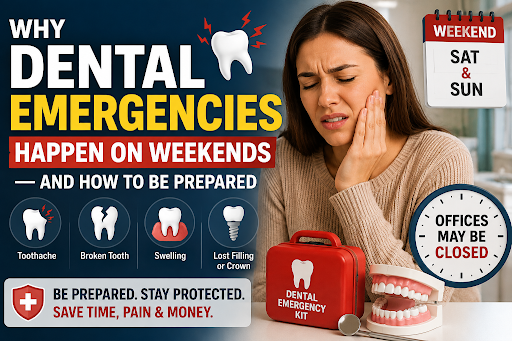
Saturday morning. Your child takes a fall at the park, and a tooth is on the ground. You freeze — not because you don’t care, but because nobody told you what to do. Most parents in Rockland County have a pediatrician’s number memorized and a first-aid kit stocked. But dental trauma? The preparation gap is striking. Knowing where to find an emergency dentist Suffern families can reach on a weekend is the baseline — and only the beginning of what your family needs to be ready.
Table of Contents
The Weekend Is Prime Time for Kids’ Dental Injuries
Saturday and Sunday concentrate everything that puts children’s teeth at risk. Youth sports, bike rides, playground activity, and recreational eating — popcorn, hard candy, ice — all peak on weekends. This is not bad luck. It is structural. Dental trauma in school-age children clusters directly around when physical activity is highest, and that window is overwhelmingly Saturday and Sunday.
High child-specific risk collides with lowest dental office availability — that is the weekend preparedness problem. The dominant misconception is that dental emergencies are random. They are not. They cluster by age group, activity type, and day of week. Parents who recognize this pattern can prepare. Those who don’t make critical decisions under panic with no plan.
The One Fact Most Parents Don’t Know — And It Changes Everything
When a tooth is knocked out, the single most important question is one almost no parent knows to ask: is it a baby tooth or a permanent tooth? The answer completely changes what you do — and getting it wrong in the first 90 seconds causes irreversible harm.
If a primary (baby) tooth is avulsed — do not replant it. Forcing it back risks damaging the permanent tooth bud beneath. Store the tooth and contact your dental office.
If a permanent tooth is avulsed — time is the treatment. Rinse gently without scrubbing the root and attempt to reinsert immediately. If that isn’t possible, store it in whole milk, saline, or between the cheek and gum. The survival window is 30 to 60 minutes.
This distinction is almost never covered during a routine checkup. Parents leave annual visits knowing their child’s cavity count — not this. That is a systemic information gap, not parental negligence. A pediatric dental emergency unfolds fast, and instinct leads most parents to make the same well-intentioned mistake.
What a Family Dental Emergency Kit Actually Needs
Every list circulating online is built for adults. Child-specific needs differ, and several commonly recommended items are not just unhelpful for pediatric cases — they are harmful.
Items That Belong in Every Family’s Kit
- Save-A-Tooth solution or whole milk — not water. Water destroys periodontal ligament cells on an avulsed root within minutes. Milk preserves them — the difference between a tooth that can be replanted and one that cannot.
- Sterile gauze pads, not cotton balls. Cotton fibers adhere to exposed pulp tissue and cause additional trauma on removal.
- Child-safe dental wax — to cover sharp broken tooth edges before you reach care.
- Your practice’s after-hours number — written down. Not saved in a phone that may be dead or locked.
- A printed permanent vs. baby tooth decision card — removes guesswork when adrenaline is high.
Aspirin placed on gum tissue — still appearing on competitor checklists — chemically burns soft tissue. It has no place in a pediatric kit.
The Pre-Game Checklist Parents Should Run Before Every Weekend
Preparedness is a decision made before Saturday. None of the following takes more than two minutes.
Five Questions to Ask Before Saturday Morning
- Is my child wearing a properly fitted mouthguard? Custom-fitted guards from a dental office offer measurably more protection than boil-and-bite — particularly for contact sports.
- Do I have the number of a dental emergency Suffern NY families can reach on weekends? A confirmed contact, stored now — not a search you plan to run later.
- Is the emergency kit stocked and accessible — not buried behind three years of unused supplies?
- Does my child have current dental vulnerabilities — a loose tooth, recent crown, or active treatment — that raises their risk this weekend?
- Do other supervising adults know the first-60-second protocol? Coaches, grandparents, and other parents are often first on scene. If they have no information, the critical early window is lost before you get the call.
That fifth question is the most overlooked. A pediatric dental emergency frequently happens outside a parent’s direct line of sight.
Why Your Family Dental Home Matters More on Weekends Than Weekdays
A family dentist is not just a provider for biannual cleanings. In a weekend crisis, they are the difference between a resolved emergency and a permanently lost tooth — and that relationship must exist before Saturday.
Familiarity is what separates a true dental home from a transactional practice. A dentist who knows your child’s history can triage accurately over the phone — no starting from zero during a panic call.
Hospital ERs manage pain and stop bleeding. They will not replant an avulsed tooth or treat exposed nerve tissue. For genuine dental trauma, an ER visit without a same-hour call to a dental provider is a lost hour. Families connected to an emergency dentist Suffern trusts — one with pediatric protocols and weekend availability — consistently have better outcomes than those running a cold search under pressure.
The preparation that matters most is the relationship built at Tuesday’s routine appointment.
Your Family Deserves a Dental Home That’s Ready When Saturday Isn’t
Promise Family Dental, at 156 NY-59 in Suffern, NY, serves children, adults, and seniors across Rockland County. The team — Dr. Jacob John, Dr. Edsel Tarife, and Dr. Eric Oh — brings decades of combined experience across general dentistry, oral surgery, and restorative care. Saturday appointments are available because dental crises don’t follow a Monday-to-Friday schedule. For families navigating a pediatric dental emergency without a plan, a trusted dental home already in place is the most important preparation you can make.
Frequently Asked Questions
- If my child’s baby tooth gets knocked out, should I try to put it back in right away?
No. Replanting a primary tooth risks damaging the permanent bud directly beneath. Keep the tooth, stay calm, and call your dental office. The protocol changes only for a knocked-out permanent tooth — where time and correct storage are both critical.
- What is the safest liquid to store a knocked-out permanent tooth in?
Whole milk. Its osmolarity is compatible with the periodontal ligament cells on the root, slowing cell death during transport. Water actively damages those cells. Saline or the space between cheek and gum are acceptable if milk is unavailable.
- The coach made the wrong call in the first few minutes. Is my child’s tooth still salvageable?
Possibly — depending on elapsed time and handling. A tooth stored dry beyond 60 minutes has a reduced replantation prognosis, but a dental evaluation is still urgent. Do not assume the outcome without professional assessment. Share the 60-second protocol with coaches and supervising adults before an emergency occurs.
- How is a pediatric dental emergency handled differently from an adult emergency?
Tooth type determination alone changes the entire protocol. Children’s developing dentition means imaging must account for unerupted teeth beneath the injury site. Pain management, sedation, and communication are all calibrated differently for young patients. A family practice with established pediatric dental emergency protocols and prior knowledge of your child’s history is far better positioned than any ER encountering them for the first time.

