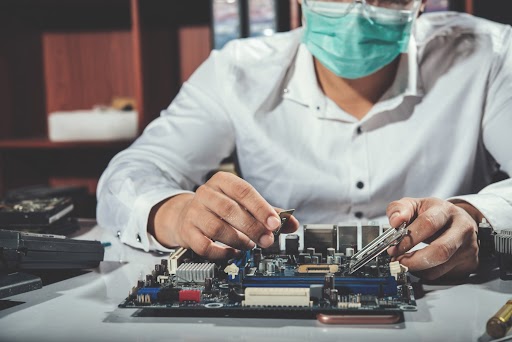
Since the 2010s, the country (and even the entire world) has seen a significant shift in how we treat electronics. Due to the sudden rise in technology advancements and tech products becoming more budget-friendly, people adopted a throwaway culture. The idea of tech repair became obsolete.
However, now that the tech products are becoming increasingly more expensive, people want their products to last longer, and independent repair specialists are rising again, especially in the realm of desktop repairs. Now, if you are interested in this career but don’t know where to begin, this guide is for you.
For starters, you’d need to explore how to become a computer technician, then once you have that down, you can focus on becoming a repair specialist. While it can seem overwhelming at first, it is very achievable.
Table of Contents
Understanding the Market for Repair Specialists
Before you start tearing down a computer, it’s important to understand the current job market and exactly where and how you fit in.
While there was a monopoly in this niche as major players like Apple and Microsoft strictly controlled how and who could repair their products, luckily, legislation has been forcing them to open up their parts catalogs.
What this means for you is that you don’t have to rely on shady websites for parts and can openly (legally) offer repair services. With that said, you still need to be certified to repair tech products.
Important Certifications and Credentials
Speaking of becoming a certified professional, there are many ways to go about it. However, it is observed that 90% of people who want to pursue this career want to become a certified repair specialist as soon as possible. Which means the four-year degree program is out of the question.
However, to bridge the skill gap and prove to authorities and your future customers that you are a legit repair professional, you need the following:
Essential Certification: CompTIA A+
This remains the industry standard. It covers the basics of hardware, software, and networking. In 2026, the A+ exam has been updated to include more on Cloud-Hybrid troubleshooting and IoT device repair.
The Vendor Badges
To be an Independent Repair Provider (IRP) for specific brands, you’ll need their specific certifications.
- Apple Certified Macintosh Technician (ACMT): Required to buy genuine Mac parts.
- Microsoft Certified: Device Support: Essential for Surface and specialized Windows hardware.
The Advanced Skills: IPC-A-610
If you want to be in the top 5% of earners, get certified in Acceptability of Electronic Assemblies. This is the Gold Standard for soldering. It proves you can perform exceptional repairs on circuit boards.
How to Set Up Your Repair Lab
Yes, lab, not just a repair shop. This is because things have changed significantly since the early 2010s. Now, customers don’t want just a random guy with a screwdriver anywhere near there $2000+ Macbook. So, your workspace needs to appear professional as well. To do so, you will need:
Thermal Imaging Camera: Used to instantly find “hot spots” on a motherboard where a short circuit is occurring.
Ultrasonic Cleaner: For professionally cleaning liquid-damaged components.
Digital Microscope: High-resolution screens are now standard for micro-soldering.
ESD-Safe Environment: Static electricity is the silent killer of modern 3nm chips. Your lab must be fully grounded.
Marketing Your Services
While getting certified and launching a workspace is relatively easy (or linear), advertising or getting customers inside of your shop is a completely different game, especially if you are not well-versed in the marketing niche.
Still, there are two ways (that work) to market your services. These are:
Local Niche Business Partnerships: Small law firms, dental offices, and creative agencies can’t wait two weeks for a manufacturer to ship a laptop back. They need “Same Day” or “On-Site” service. Position yourself as the Local Hardware Lead.
The “Content” Strategy: Start a YouTube channel or make an Instagram page showing why a device failed. When people see you explaining a complex motherboard repair, they see an expert. You aren’t selling a repair; you’re selling certainty.
90-Day Roadmap to Becoming a Repair Specialist
It’s understandable if you are overwhelmed with all the certs and other requirements. To simplify the process, here’s an easy-to-follow path after you’ve completed your computer tech training.
Days 1-30: Go through the study material (included in your training program) and revise as much as you can.
Days 31-60: Register and pass your CompTIA A+ Core 1 and Core 2.
Days 61-90: After getting certified, buy a broken (either hardware or software issues) MacBook or gaming laptop on eBay. Record a video for your YouTube channel as you fix it, and upload with an appropriate title and hashtags.
Endnote
If you are still uncertain about entering this niche, just know that the independent repair world is completely different from what it was in the last 5-6 years. It is now profitable and sustainable. Also, even if rules change (which is highly unlikely) and you can no longer work as an independent repair professional, you can also find a role as a computer technician in the IT world.

