
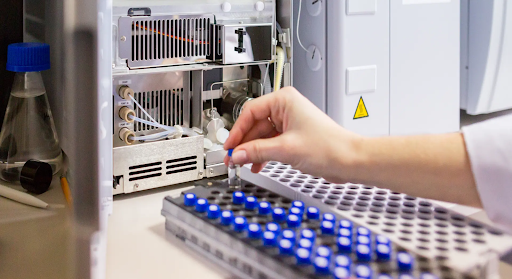
In modern drug development, the demand for precise and sensitive analytical techniques is higher than ever. Liquid Chromatography-Mass Spectrometry (LC-MS) has emerged as the gold standard in this arena, providing the robust data necessary to evaluate drug safety and efficacy. This article examines the fundamental principles of LC-MS testing, its specific application in bioanalysis and pharmacokinetic (PK) studies, and the future trends shaping this technology.
Table of Contents
Application in Bioanalysis
Bioanalysis involves the quantitative measurement of drugs, metabolites, and biomarkers in biological systems. An LC-MS assay is critical in this field because it can analyze complex biological matrices, such as blood, plasma, serum, and urine.
Quantifying Drugs and Metabolites
In bioanalysis, the primary goal is to determine drug concentration in a sample. LC-MS quantifies analytes by comparing the sample response to a calibration curve from known standards. The high selectivity of MS detection ensures that the signal measured corresponds specifically to the drug of interest, even in the presence of other endogenous compounds.
Sample Preparation Techniques
Before an LC-MS Lab Test can be performed, the biological sample must be processed to remove interferences and extract the analyte. Common techniques include:
- Protein Precipitation (PPT): A simple method where organic solvents are added to the sample to precipitate proteins, leaving the drug in the supernatant.
- Solid-Phase Extraction (SPE): Uses a solid stationary phase to selectively bind the analyte while washing away impurities, followed by elution of the clean sample.
- Liquid-Liquid Extraction (LLE): Relies on the differential solubility of the analyte between two immiscible liquid phases to separate it from the matrix.
The Role of Internal Standards
To ensure accuracy, LC-MS method development almost always incorporates internal standards. An internal standard is a compound similar to the analyte (often a stable isotope-labeled version) added at a constant concentration to all samples. By measuring the ratio of the analyte response to the internal standard response, analysts can correct for variations in sample preparation and instrument performance.
Pharmacokinetic (PK) Studies
Pharmacokinetics examines how the body affects a specific drug after administration. It tracks the compound’s absorption, distribution, metabolism, and excretion (ADME). Clinical Bioanalysis Services rely heavily on LC-MS to generate the concentration-time data required for these analyzes.
Determining Drug Concentration Over Time
In PK studies, samples (usually plasma or urine) are collected from subjects at specific time intervals after dosing. LC-MS analysis of these samples provides a detailed profile of how drug concentrations change over time. This data is essential for both preclinical studies and clinical trials.
Key PK Parameters
The concentration-time data generated by LC-MS allows researchers to calculate vital PK parameters:
- AUC (Area Under the Curve): Represents the total drug exposure over time.
- Cmax: The maximum concentration of the drug observed in the body.
- Tmax: The time at which Cmax is reached.
- T1/2 (Half-life): The time required for the concentration of the drug to decrease by half.
These parameters help determine appropriate dosing regimens and predict potential toxicity or lack of efficacy.
Advantages of LC-MS in Drug Development
The dominance of LC-MS in bioanalysis stems from several distinct technical advantages:
- High Sensitivity: Modern instruments can detect analytes at picogram or even femtogram levels, which is necessary for potent drugs administered at low doses.
- Selectivity: Mass spectrometry differentiates compounds by mass, reducing the risk of interference from co-eluting peaks that might affect other detection methods, such as UV-Vis.
- Multiplexing: LC-MS can analyze multiple compounds simultaneously. This allows researchers to track a parent drug and several metabolites in a single run, increasing throughput and efficiency.
- Versatility: The technology applies to a vast range of molecule types, from small organic molecules to large biological peptides and proteins.
LC-MS is a powerful tool, offering precision and adaptability across many analytical applications.
Recent Advances and Future Trends
The field of lc ms Testing continues to evolve, driven by the need for faster results and lower detection limits.
Sensitivity and Throughput
Newer generations of mass spectrometers offer enhanced ion transmission efficiencies and faster scan speeds. This allows for shorter run times without sacrificing data quality. Additionally, automated sample preparation platforms are increasing the number of samples an lc ms laboratory can process daily.
High-Resolution Mass Spectrometry (HRMS)
While triple quadrupoles remain the standard for quantification, HRMS is gaining traction in quantitative bioanalysis. HRMS enables full-scan data acquisition, allowing researchers to retrospectively analyze data for metabolites or biomarkers that were not originally targeted.
Microfluidic Systems
The integration of microfluidic LC systems reduces solvent consumption and sample volume requirements. This is particularly beneficial for pediatric studies or preclinical research where sample volume is limited.
Conclusion
LC-MS testing is essential for bioanalysis and pharmacokinetic studies, providing accurate and sensitive measurement of drugs and metabolites in complex biological samples. Its high selectivity and versatility support key decisions throughout drug development, from early research to clinical trials. With ongoing advances in instrumentation and automation, LC-MS continues to improve speed, accuracy, and efficiency, ensuring reliable data for the development of safer, more effective medicines.