
Have you ever wondered how your favorite patches are made? The backing of your custom patch is crucial to its adhesive and longevity. Custom patches are not just for looks. They are symbols of corporate pride, identification, and branding. The right backing will increase the performance of your custom patch.
Iron-on and Velcro are the two most popular types, and both have their advantages. While both offer personalization and decoration, it is important to note the differences when selecting the right custom patch for your needs. Choosing the right backing is as important as designing the patch.
Improper backing can cause damage to the fabric or patches that peel off. With the correct backing, your patches will be secure, polished, and long-lasting. Let’s look at both sorts of backing and their benefits and why you should choose one over the other to help you make a decision.
Table of Contents
Pros, Cons, and Best Uses
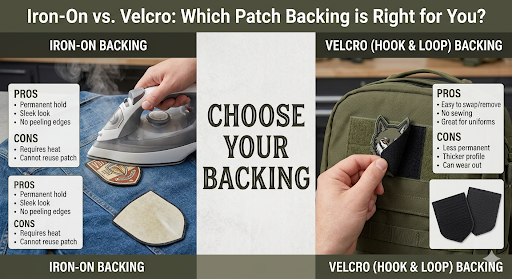
An iron or heat press is used to apply iron-on backing. It’s a great way to create a long-lasting, polished connection. The application process is simple and quick, usually lasting only 15 to 30 seconds. It’s perfect for things like work uniforms, sports jerseys, hats, and bags that won’t need to have their patches changed frequently.
It is ideal for people or companies that need to patch in large quantities because it needs no skill and doesn’t require sewing. As the custom iron-on embroidered patches are made to resist frequent wear and washing, the bond is robust and long-lasting. Additionally, it works with a variety of materials, such as canvas, denim, cotton, and polyester.
When Is Iron-On Better than Velcro?
When you want a smooth, flawless appearance and a durable bond, iron-on is the best option. It is great for long-lasting patches on jackets, luggage, and workwear. It’s also an excellent choice for big orders of custom patches because the application is swift and consistent.
Velcro Patches
The Velcro backing, also referred to as hook and loop, has two parts. There is the hook component that attaches to the patch, and then there is the loop component that gets stitched or glued to the clothing. Velcro patches are removable, reusable, and replaceable.
They are therefore best suited for use in uniforms, tactical gear, and kids’ clothing, among others, since the patches have to be replaced often. Velcro patches have a secure fit but are also flexible. They are easy to use, and no stitching or ironing is necessary. Therefore, anyone can use Velcro patches, even those without stitching expertise.
Why Choose Velcro Over Iron-On?
Custom Velcro hook embroidered patches would be a great choice if you want to easily change patches on uniforms, tactical vests, or children’s clothes. They would also be a great choice if you don’t want to sew or iron, since no application is required.
Which Backing Would Be the Right Choice
The choice between iron-on and Velcro depends on what you plan to use your patches for.
When to Choose Iron-On
Iron-on patches should be chosen if you need a permanent bond. This backing is ideal if you need to embellish a denim jacket, pants, or a backpack, if you don’t need to remove the patches. This type of patch has a smooth, flush look. They are best used on a flat cotton or denim surface where full adhesion can be achieved.
They provide a strong, long-lasting bond to the fabric. They can be washed repeatedly without losing adhesiveness. Iron-on patches are best used on formal wear or if you need a professional look.
When to Choose Velcro Patches
If you plan on changing the patches frequently, Velcro is the right choice. It is easier to install and remove them without damaging the base material. This is particularly useful for uniforms, headgear, and accessories that require frequent customization.
It is perfect for temporary uses such as branding at trade exhibitions, military gear, team jackets, and children’s wear, where patches might need to be changed often. Velcro does not require any special devices such as a heat press, iron, or sewing machine to apply it to fabric. It presses together easily. It is also useful for materials that cannot withstand high temperatures.
What’s Next
To make a custom patch, start with your idea, whether it is a logo, a sketch, or a theme. If your idea is not clear, a good way to clarify it is to write it down, since most vendors prefer a sketch or a screenshot to create professional artwork.
Choose Your Patch Type
Once you have a clear idea, consider the type of patch that best suits your needs. Embroidered patches make a dramatic effect, woven patches use thin threads for a clear image, PVC patches are soft, waterproof, and incredibly durable, and printed patches provide a clear image in any color you need.
Select Size, Shape, and Backing
The next step is to choose the size, shape, and backing of the patch. Larger patches allow more complex designs, while smaller ones require minimal designs. The backing you choose, such as iron-on for convenience, sew-on for longevity, and Velcro for flexibility, affects how well the patch adheres to the fabric.
Turn Your Ideas Into Reality
Once production begins, a digital proof will be sent to you to check the design’s color, border, and text readability. You can make changes until you are completely satisfied with the design. Once your design is complete and the right patch is chosen, you can look forward to your personalized patch bringing your vision to life on your denim jacket.
Now It’s Your Turn
Now that you’ve learned about backings, patch types, and creating your own custom design, you can use iron-on for a strong bond and Velcro when you need to change things easily. You have also learned that embroidered, woven, PVC, and printed patches add that unique touch to your denim jacket.
What’s left is to take the first step. Do you have a design in mind or just a spark of an idea? The process ahead is not as complicated as you think. Do you have a sketch, a logo, or just a theme in mind? Choose your patch type and backing. The experts will handle the rest for you.
Each customized jacket starts as a single patch. Your story is waiting to be worn. Your task now is to bring it to life.
Conclusion
The right backing determines how well your patch performs. If you use iron-on, you get a permanent bond that works well for denim jackets and work clothing. If you use Velcro, you get a bond that’s easy to remove and switch out, making it perfect for uniforms, tactical gear, and kids’ clothing that needs to be versatile.
The type of backing you use ensures that your patches are secure, professional, and long-lasting. A custom patch acts as more than just a decorative piece; it becomes a symbol of your individuality.
Now that you’ve chosen the backing that works best for you, it’s time to put your plan into action. Your denim jacket becomes a canvas for your story, giving you a chance to turn your ideas into reality and express your unique personality.