
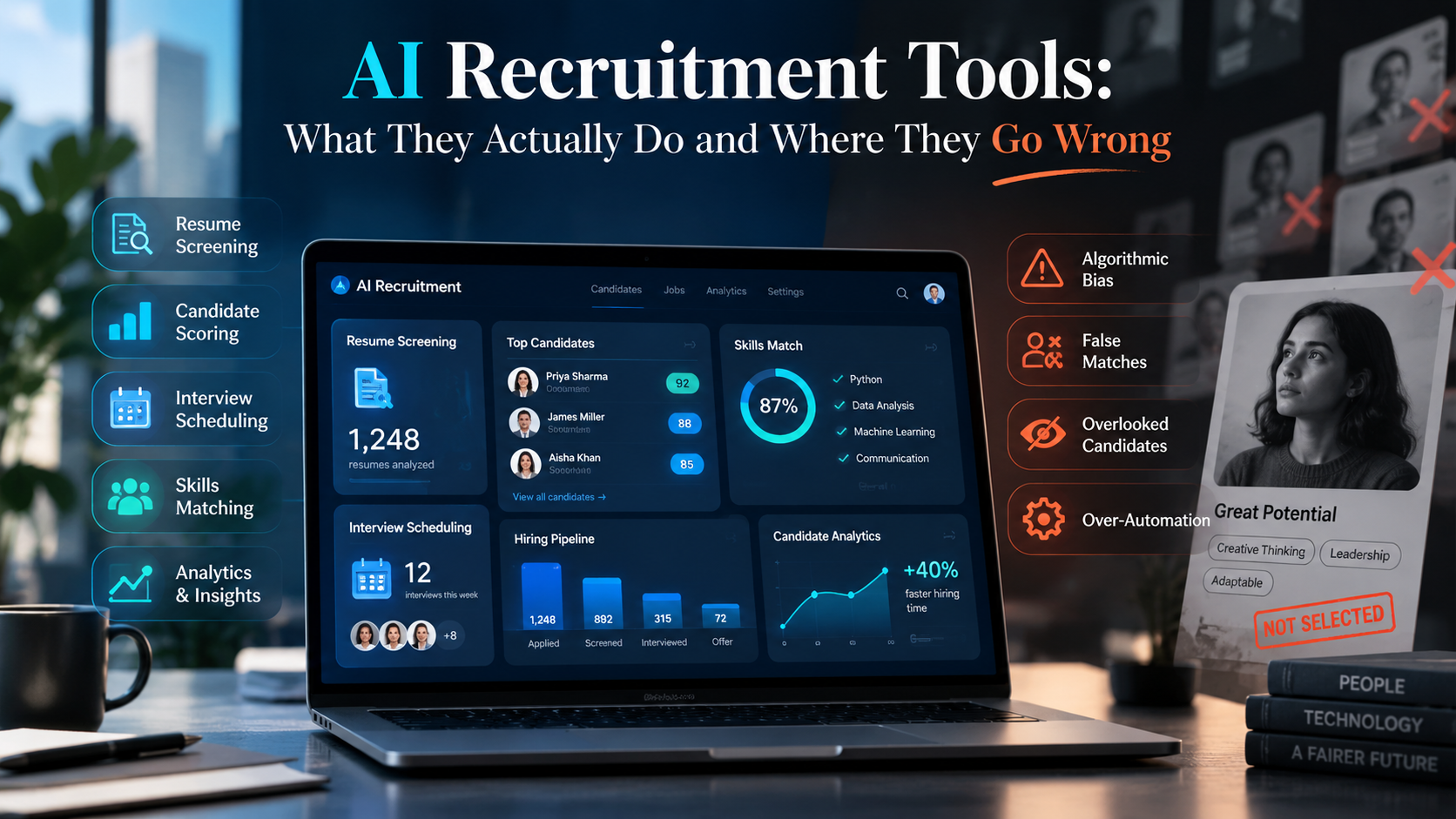
Every hiring tool now has “AI” on the box. Some of them genuinely save your team hours each week. Others quietly reject good people, and a few have landed companies in court.
This guide cuts through it. You will see what these tools really do, which ones are worth a look, what the free options give you, and the mistakes that cost real money.
Table of Contents
What are AI recruiting tools?
AI recruitment tools are software that handle parts of hiring that used to need a person. They write job posts, find candidates, read and rank CVs, run first-round chats or video screens, book interviews, and summarise notes.
They do not decide who to hire. They decide who you see. That is the part most buyers miss, and it is where the risk sits.
The five main types are sourcing, screening, scheduling, interviewing, and writing. Pick tools by the job you want done, not by the word “AI” on the pricing page.
How Is AI Used in Recruitment? The 5 Main Types
Searches for “what are the 5 main AI tools” usually mean these five jobs. Here is what each one does.
| Type | What it does | Watch out for |
|---|---|---|
| 1. Sourcing | AI sourcing tools for recruiting search job boards, LinkedIn and your own old applicants to find people who fit a role | They can only find people already in a database. Narrow filters quietly shrink your pool |
| 2. Screening | Reads CVs, gives each a match score, ranks or auto-rejects | This is where bias does the most damage. Never let it auto-reject without a human check |
| 3. Scheduling | Books interviews, handles reschedules, sends reminders | The safest type to start with. Almost no risk, clear time saved |
| 4. Interviewing | Runs chat screens, one-way video interviews, or scores recorded answers | Video scoring is the most questioned type. Accent, lighting and disability can all affect scores |
| 5. Writing and summarising | Drafts job posts, outreach emails, interview questions, and turns interview notes into summaries | Output sounds polished but can be generic or wrong. Always read before sending |
A sixth job worth knowing: CV anonymisation. It hides names, gender and photos before a human reads the CV. Greenhouse lists this as a standard feature, and it is one of the few AI features that reduces bias instead of adding to it.
Best AI Recruitment Tools: A Side-by-Side Look
Use this AI recruitment tools list as a shortlist, not a ranking. These are tools covered in detail by SelectSoftwareReviews, an independent review site, as of October 2026. Prices come from that page and change often, so confirm before you buy.
| Tool | Best for | Starting price (listed Oct 2026) | Notable |
|---|---|---|---|
| Workable | Small and mid-size teams wanting one platform | $299/month (Standard) | AI job posts, screening assistant, video interviews, sourcing. Posts to 200+ job sites |
| Manatal | Teams on a tight budget | $15 per user/month (annual) | AI matches job descriptions to your talent pool. Cheapest full tool on the list |
| Recooty | Small teams wanting a simple start | $79/month (Starter) | Match scores, candidate summaries, 8 languages, 15-day trial |
| Greenhouse | Companies that want structured, fair hiring | Not published | Strong on structured interviews and CV anonymisation. 450+ integrations |
| Paradox | High-volume hiring (retail, BPO, warehouses) | Not published | “Olivia” chatbot handles screening and booking. Candidate Q&A in 100+ languages |
| Pinpoint | Teams that want to see why a score was given | $345/month (Growth, annual) | Explainable match scores, CV redaction, human-approval step built in |
| Humanly | Mid-size teams wanting conversational screening | Not published | Screening, scheduling, reference checks, interview intelligence |
A note on this table: SelectSoftwareReviews says it earns a fee when readers click through to some vendors. That does not make the reviews wrong, but it is worth knowing. Treat any “best tools” list, including this one, as a starting point and run your own trial.
What we could not verify: several vendors publish time-saving claims (one says 80% less CV review time) with no independent testing behind them. Ask any vendor how they measured such a number before you believe it.
How Many Recruiters Actually Use AI?
The honest answer is that adoption is high and rising, but the numbers move depending on who ran the survey.
- 65% of recruiters said they are already using AI tools, in an Employ Inc report.
- 59% said they currently use AI to surface candidates they would otherwise miss, per LinkedIn research.
- 66% plan to increase AI use for pre-screening interviews, and 93% of talent acquisition professionals said they planned to grow AI use in 2026, also per LinkedIn. HR Dive report
Neither survey published its sample size in the coverage we read, so treat these as direction, not precision.
On the candidate side, 52% of job seekers said they have been ghosted by an employer, per Greenhouse’s 2024 Candidate Experience Report. That is the problem good automation is supposed to solve: replies that actually arrive.
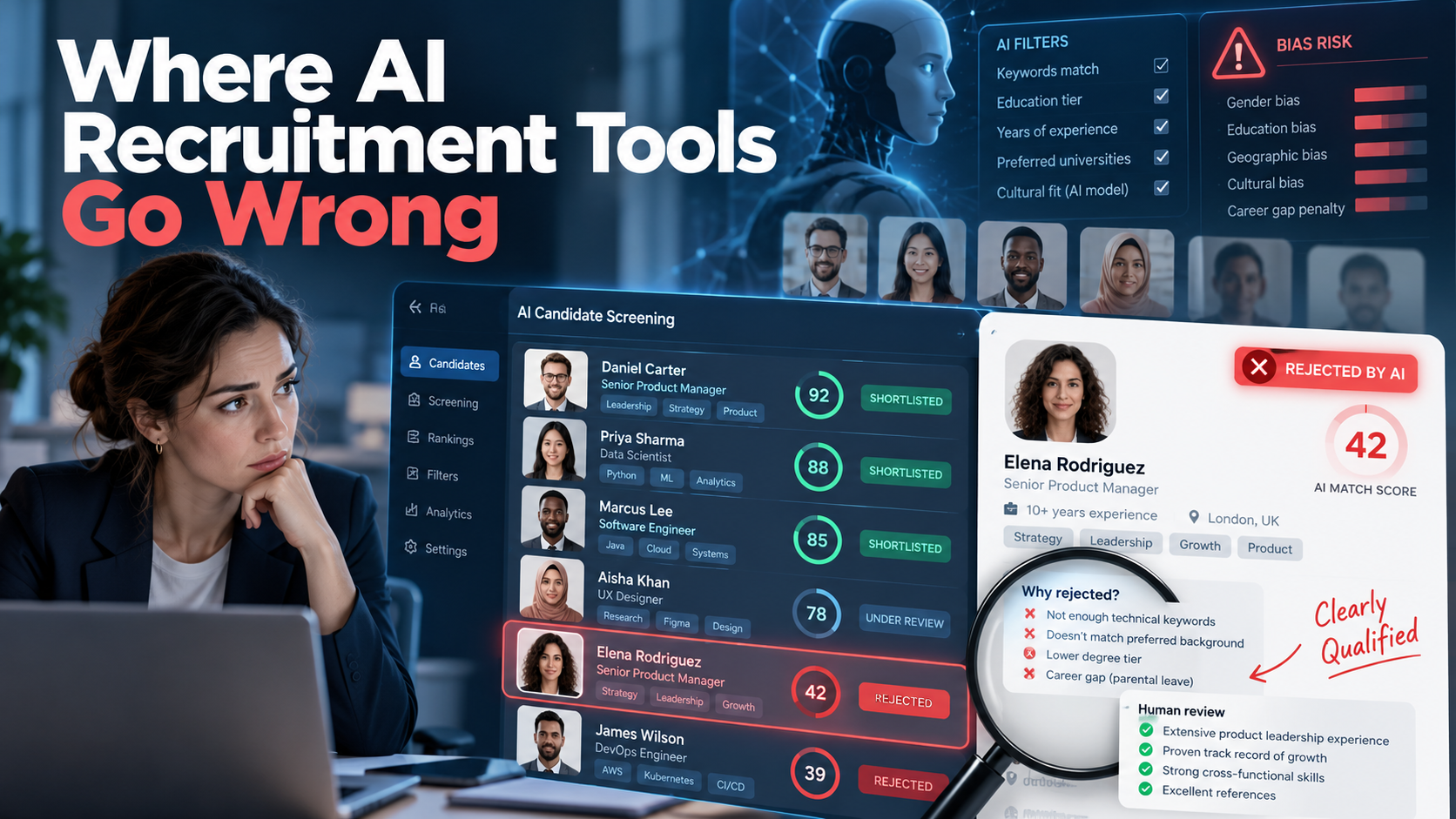
Where AI Recruitment Tools Go Wrong
This is the section most vendor pages skip. All four cases below are documented.
1. Amazon’s tool taught itself to downgrade women
Amazon built a CV-screening tool and scrapped it in 2018 after finding it penalised CVs containing the word “women’s,” such as “women’s chess club captain.” The system had learned from ten years of mostly male CVs and concluded that male candidates were preferable. MIT Technology Review
The lesson: an AI trained on your past hiring will repeat your past hiring, including the parts you are trying to fix.
2. A company paid $365,000 for an age filter
The US Equal Employment Opportunity Commission sued iTutorGroup, alleging its hiring software automatically rejected women aged 55 or older and men aged 60 or older, screening out more than 200 applicants. The case came to light when one applicant sent two identical applications that differed only in date of birth, and got an interview only with the later date.
iTutorGroup settled for $365,000 in August 2023, without admitting wrongdoing. Sullivan & Cromwell summary
The lesson: a rule somebody typed into a settings screen is still discrimination. “The software did it” is not a defence.
3. The vendor can be on the hook too
In Mobley v. Workday (N.D. Cal., case no. 3:23-cv-00770), applicants allege Workday’s AI screening discriminated on race, age and disability. The court rejected the idea that Workday was an “employment agency,” but allowed the claim that it acted as an agent of its customers, finding it plausible that employers had handed over the job of advancing and rejecting candidates. A federal court allowed the case to proceed as a collective action in 2025, and it remains in discovery. Akin Gump tracker · Holland & Knight
The lesson: the more decision-making you hand to the tool, the more both you and the vendor carry.
4. The quieter failures nobody sues over
Not every problem ends in court. These are the ones hiring teams actually report:
- Good people filtered out by keyword matching. A CV that says “led a team of 12” may score below one that happens to use your exact phrasing.
- Career gaps read as weakness. Parents, carers and people recovering from illness get pushed down.
- Generic outreach at scale. AI lets you send 500 bad messages instead of 50 good ones. Reply rates fall.
- Nobody can explain the score. When a candidate asks why they were rejected, “the system ranked you 61” is not an answer.
The Rules You Need to Know Before You Switch On
Rules differ sharply by where your candidates are, not where your office is.
| Where | What applies | What it means in practice |
|---|---|---|
| New York City | Local Law 144 | An automated employment decision tool must have a bias audit done within the past year, a summary published on your website, and candidates given at least 10 days’ notice. Enforcement began 5 July 2023. Fines up to $500 for a first violation, then $500 to $1,500 each |
| European Union | EU AI Act | Recruitment AI is classed as high risk. Employers must provide trained human oversight and tell affected workers and their representatives before deploying it. The timetable is in flux: obligations were set for August 2026, and a proposed “Digital Omnibus” could push parts to late 2027 or 2028. It is still a proposal, so prepare for the earlier date |
| India | No AI-specific law yet | The Digital Personal Data Protection Act, 2023 governs personal data but, per an Observer Research Foundation analysis, does not address automated decision-making in hiring or require transparency about algorithms. Existing labour and anti-discrimination law was written for human decisions |
Sources: Perkins Coie on Local Law 144 · Crowell on the EU AI Act and HR · ORF on AI recruitment in India
If you hire in India: the absence of a rule is not the absence of risk. If you hire for US or EU roles, their rules follow the candidate. And a tool that quietly filters by age, gender or region can still breach Indian labour and equality law, whoever wrote the code.
We are not lawyers. Check with your legal team before you deploy a screening tool, especially across borders.
AI Recruitment Tools in India: What’s Different
Indian hiring teams face a particular mix:
- Volume is the problem. A single opening can draw thousands of applications. This is exactly where screening and scheduling tools earn their cost.
- Adoption is growing without rules. ORF notes rising use of applicant tracking systems and video interview platforms in IT, finance and ed-tech, while India “currently lacks any AI-specific regulation.”
- Language and name bias is a live risk. Models trained mostly on Western CVs can misread Indian names, colleges and job titles. Test with your own past candidates before trusting any score.
- Price matters more. Tools billed per user per month (Manatal at $15) suit Indian team budgets better than platform fees of $299 and up.
Our suggestion for Indian teams: start with scheduling and CV parsing, which save real hours with almost no risk. Add screening only once you have tested it against CVs you already judged by hand.
Free AI Tools for Recruitment: What You Really Get
“Free” usually means a limited tier, not a free product. Here is what is on offer, as listed by Manatal in 2026. Manatal sells a paid product, so read its list with that in mind.
| Tool | Free plan limits |
|---|---|
| Freshteam (Freshworks) | Sprout plan: 3 active job postings, up to 50 employees |
| Dover | No caps listed on job posts, candidates or users |
| Wellfound | Free applicant tracking, but no distribution to outside job boards |
| iKrut | No caps on jobs, candidates or users, but no CV parsing, automation or advanced analytics |
| VanHack | Free tool, with a placement fee of about 20% of first-year salary per hire |
What free plans almost never include: bias auditing, explainable scoring, integrations with your HR system, and support when something breaks. For a handful of roles a year, free is fine. For continuous hiring, the hidden cost is your team’s time.
Also worth knowing: general AI assistants can draft job posts and interview questions at no cost. They are not recruitment tools, they keep no candidate records, and you should never paste candidate personal data into them.
How to Choose: A 7-Point Check
Run every tool through this before you sign.
- Name the job first. “We lose two days a week to scheduling” is a brief. “We need AI” is not.
- Ask how the score is produced. If the vendor cannot explain why one CV scored 80 and another 60, you cannot defend the decision later.
- Ask for the bias audit. Who ran it, when, and what did it find? If there is none, that is your answer.
- Test on CVs you already judged. Feed in 50 past applicants. Does it rank the people you actually hired near the top?
- Keep a human on every rejection. Use AI to rank and shortlist. Do not let it auto-reject.
- Check what happens to candidate data. Where is it stored, for how long, and who else sees it?
- Trial it properly. One real role, one month, with your own team. Vendor demos use vendor data.
What AI Still Cannot Do in Hiring
Being clear about this saves disappointment:
- Judge whether someone will fit your team. It can match words, not character.
- Spot the unusual candidate worth a risk. Pattern matching rewards people who look like past hires.
- Replace a proper interview. It can summarise one. It cannot have one.
- Make a bad job description attractive. Garbage in, polished garbage out.
- Fix a slow hiring process. If three managers take two weeks to reply, no tool will save you.
Frequently Asked Questions
Which AI tool is best for recruitment?
There is no single best tool, because it depends on the job you need done. For high-volume hiring, Paradox is widely used. For structured, fair hiring, Greenhouse is strong. For small budgets, Manatal starts around $15 per user a month. Shortlist two, trial both on one real role, then decide.
How is AI used in recruitment?
AI is used in five main ways: finding candidates, reading and ranking CVs, booking interviews, running first-round chat or video screens, and writing job posts and summaries. Most teams start with scheduling and CV parsing, which save time with little risk, and add screening tools later with human review.
What are the 5 main AI tools in hiring?
The five main categories are sourcing, screening, scheduling, interviewing and writing. Sourcing finds people, screening ranks them, scheduling books the meetings, interviewing runs or scores first rounds, and writing drafts job posts and summaries. Many platforms bundle several of these together rather than selling them separately.
What AI tools are used in HR?
Beyond recruitment, HR teams use AI for onboarding checklists, chatbots that answer policy questions, performance review summaries, learning recommendations, and workforce analytics. Recruitment tools are usually the first step, because hiring has the clearest repetitive work and the easiest time savings to measure.
Are AI recruitment tools free?
Some have free tiers. Freshteam’s Sprout plan allows 3 active job postings for up to 50 employees, and Dover, Wellfound and iKrut offer free applicant tracking with various limits. Free plans rarely include bias auditing, explainable scoring or integrations, so they suit occasional hiring rather than continuous recruitment.
Can AI recruitment tools be biased?
Yes. Amazon scrapped a CV tool in 2018 after it downgraded CVs mentioning women’s activities, and the EEOC settled a case for $365,000 where software rejected applicants by age. Bias usually comes from training data that reflects past hiring. Test any tool on your own past candidates before trusting its scores.
Is AI hiring legal in India?
There is no AI-specific hiring law in India yet. The Digital Personal Data Protection Act, 2023 covers personal data but, per an ORF analysis, does not address automated decision-making in hiring. Existing labour and anti-discrimination law still applies, and if you hire for US or EU roles, their rules follow the candidate.
Do I still need recruiters if I use AI?
Yes. AI handles repetitive work such as sorting, booking and drafting. It cannot judge team fit, negotiate an offer, read hesitation in an interview, or decide when an unusual candidate is worth a risk. Teams that cut recruiters entirely tend to lose candidates to slow, impersonal processes.
Sources
- SelectSoftwareReviews: AI recruiting software buyer guide
- Greenhouse: What are AI recruiting tools
- HR Dive: Recruiters increasing AI usage
- MIT Technology Review: Amazon ditched AI recruitment software
- Sullivan & Cromwell: EEOC settles first AI discrimination lawsuit
- Akin Gump: Mobley v. Workday tracker entry
- Holland & Knight: Federal court allows collective action over AI hiring bias
- Perkins Coie: NYC final rules on automated employment decision tools
- Crowell: AI and human resources in the EU, 2026 legal overview
- Observer Research Foundation: Hired by an algorithm
- Manatal: Best free ATS for recruiters in 2026