
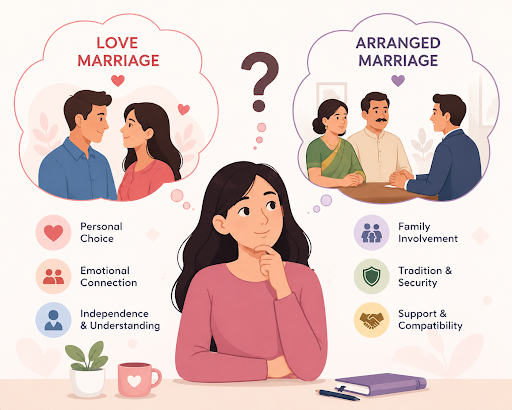
Marriage is rarely just about finding someone you like.
It can involve family expectations, personal independence, cultural traditions, financial plans, career goals and the kind of life you want to build.
That is why the question of love marriage or arranged marriage can be more complicated than it first appears.
Some people want to choose their partner independently. Others prefer introductions through family. Some are comfortable with either approach as long as they have enough time to know the person before making a commitment.
A Love or Arranged Marriage Calculator offers a numerology-based way to explore these tendencies.
Rather than treating the result as a fixed prediction, it can be more useful as a prompt for understanding how you approach relationships and major personal decisions.
Table of Contents
What Is a Love or Arranged Marriage Calculator?
A Love or Arranged Marriage Calculator is an online numerology tool designed to provide an interpretation about a person’s possible relationship or marriage preferences.
The exact methodology varies between calculators.
Some use the date of birth to calculate a Life Path Number. Others incorporate birth numbers, the Lo Shu Grid or additional numerological calculations. Some astrology-based tools also combine numerology with birth-chart information.
A numerology-only calculator should therefore not be confused with a full Vedic astrology reading.
The result is best viewed as an interpretation rather than a guarantee.
Why People Ask This Question
The love-versus-arranged question often appears when someone is thinking seriously about their future.
Perhaps they’re in a relationship and wondering how their family might react.
Maybe their parents have started suggesting potential partners.
Or they may simply be curious about which approach suits their personality.
Behind the question is usually something deeper:
How much control do I want over choosing my life partner?
That is a useful question even without numerology.
Love Marriage and Arranged Marriage Are Not Completely Separate
The two terms are often presented as opposites.
In reality, there is a lot of middle ground.
A couple may meet independently, fall in love and then involve both families in the marriage process.
Another couple may meet through relatives but spend months getting to know each other before deciding whether to marry.
This is sometimes described as a love-cum-arranged marriage.
The important distinction is therefore not simply who introduced the couple.
It’s how much personal choice, family involvement and mutual agreement exist throughout the process.
How Does the Numerology Calculation Work?
A common numerology approach begins with your date of birth.
For example, imagine someone was born on:
18 July 1997
The digits can be added:
1 + 8 + 0 + 7 + 1 + 9 + 9 + 7 = 42
Then:
4 + 2 = 6
The resulting number can be interpreted according to the numerological system being used.
Some systems preserve certain numbers as master numbers, while others continue reducing them.
That is why two calculators may produce different interpretations from the same birth date.
The methodology matters.
What Do Different Numbers Traditionally Suggest?
Numerology traditions associate different numbers with different characteristics.
These interpretations can provide an interesting way to think about relationship preferences.
Number 1
Often associated with independence, initiative and self-direction.
Someone who strongly identifies with these qualities might prefer having greater control over major life decisions.
Number 2
Traditionally connected with cooperation, relationships and sensitivity.
This may resonate with people who place considerable importance on partnership and harmony.
Number 3
Often associated with communication, creativity and expression.
For relationships, communication may be the most relevant theme.
Number 4
Commonly connected with stability, structure and practicality.
Someone who values security and predictable planning may relate to this interpretation.
Number 5
Often associated with freedom, flexibility and change.
This can encourage reflection about how much independence someone wants within a relationship.
Number 6
Traditionally linked with family, responsibility and care.
Family involvement and long-term stability may feel particularly important to someone who resonates with these themes.
Number 7
Often associated with introspection, analysis and privacy.
This may encourage someone to think carefully before making a major emotional commitment.
Number 8
Commonly connected with ambition, organisation and practical achievement.
Career and financial stability may therefore become important considerations when thinking about marriage.
Number 9
Traditionally associated with compassion, broader purpose and emotional depth.
A person may place greater emphasis on shared values and a sense of purpose.
These are traditional numerological interpretations, not psychological diagnoses.
A Better Way to Read Your Result
Suppose a calculator suggests that your numbers are more aligned with a love-led relationship.
You don’t have to conclude:
“Therefore, I will definitely have a love marriage.”
Instead, ask:
“Do I naturally prefer choosing my own partner?”
If the answer is yes, the result may feel relevant.
If your answer is no, that’s useful information too.
The same applies to an arranged-marriage interpretation.
A number may suggest that you value family involvement, structure or stability.
You can then decide whether those qualities actually describe you.
The goal is reflection, not surrendering your decision-making to a number.
A Practical Example
Imagine someone whose family has started introducing potential partners.
They aren’t opposed to arranged marriage.
But they want to spend enough time with someone before deciding.
At the same time, they have never actively dated and don’t know whether they would prefer finding a partner independently.
A numerology result may give them one perspective on their relationship tendencies.
But the more useful exercise is to identify their actual priorities.
They might write:
- I want family approval.
- I also want personal choice.
- I need time to understand someone’s personality.
- Career goals must be compatible.
- I want both partners to have financial independence.
- I value open communication.
Now the decision is much clearer.
The person isn’t choosing between two labels.
They’re defining what a successful relationship looks like to them.
Family Influence Doesn’t Have to Mean Losing Choice
In many families, relatives play an important role in introducing potential partners.
That doesn’t automatically make the process negative.
Family members may know people with similar backgrounds, values or expectations.
The problem arises when introduction becomes pressure.
A healthy process allows both people to ask questions, take time and make an independent decision.
Whether a relationship begins through a dating app, a friend or a family introduction, both people should ultimately be comfortable saying yes.
What Should You Discuss Before Deciding?
If you’re seriously considering marriage, don’t limit the conversation to attraction.
Talk about real life.
Career
What are your professional goals?
Would either person be expected to relocate?
Finances
How do you approach saving and spending?
How will major financial decisions be made?
Family
How involved should parents and relatives be?
Children
Do both partners want children?
What are their expectations about timing and parenting?
Lifestyle
How do you want to spend your everyday life?
Communication
Can you disagree without becoming disrespectful?
Independence
How much personal space does each person need?
These questions can reveal compatibility far better than a simple love-versus-arranged label.
How to Use a Love or Arranged Marriage Calculator
If you’re interested in numerology, you can use a Love or Arranged Marriage Calculator to explore the traditional interpretation associated with your birth details.
Once you receive the result, don’t stop at the final category.
Ask yourself:
Does this describe how I normally approach relationships?
How important is personal choice to me?
How much influence do I want my family to have?
What do I need from a partner?
Which parts of the interpretation don’t fit me?
That last question is important.
You don’t need to agree with every result.
One Common Mistake: Looking for Certainty
Marriage is a major life decision, so people naturally want certainty.
A calculator can feel attractive because it appears to offer a straightforward answer:
Love or arranged?
But relationships aren’t that simple.
A person can meet their partner through family and develop a deep romantic connection.
Someone can choose a partner independently and later discover major incompatibilities.
The way a relationship begins doesn’t determine whether it succeeds.
Compatibility Is Built Over Time
Even a strong initial connection doesn’t guarantee a successful marriage.
People change.
Careers change.
Financial circumstances change.
Families grow.
Responsibilities increase.
The ability to adapt together can therefore be more important than the circumstances of the first meeting.
That’s why communication and shared expectations deserve more attention than simply predicting the marriage type.
What If Your Result Doesn’t Match Your Situation?
That’s completely possible.
You might receive an arranged-marriage-oriented interpretation while already being in a serious relationship.
Or you may get a love-marriage interpretation even though you prefer family introductions.
The result doesn’t invalidate your experience.
Numerology is a traditional interpretive framework, not an established scientific method for predicting personal relationship outcomes.
Current calculators in this space vary significantly in their methodologies and generally differ in whether they use numerology alone or combine it with astrology.
Use the result as something to think about, not something you must obey.
Love Marriage Does Not Mean Better Compatibility
It’s easy to assume that choosing your partner personally gives you an automatic advantage.
It doesn’t.
A couple who dated for five years may still discover serious differences after marriage.
Likewise, two people introduced by their families can build a strong relationship if they communicate honestly and share compatible expectations.
The starting point matters.
But what happens afterward matters much more.
Arranged Marriage Doesn’t Mean There Is No Romance
Another common misconception is that arranged marriage is purely practical.
That isn’t necessarily true.
Two people can meet through their families and develop attraction, affection and emotional closeness before deciding to marry.
The relationship can evolve naturally after the introduction.
In fact, some couples deliberately combine family involvement with personal choice.
That’s why “arranged” doesn’t have to mean “emotionless,” just as “love” doesn’t automatically mean “perfect compatibility.”
A Simple Relationship Decision Checklist
Before making a serious marriage decision, ask yourself:
- Do I feel comfortable being myself around this person?
- Can we discuss difficult subjects?
- Do we respect each other’s careers?
- Are our financial expectations reasonably compatible?
- How will we handle family involvement?
- Do we agree about children?
- Are we comfortable with each other’s lifestyle?
- Can we disagree without disrespect?
- Do I feel free to say no?
- Am I choosing this person because I genuinely want to, or because I’m afraid of disappointing someone?
That last question can be especially revealing.
Can Numerology Predict Your Marriage?
Numerology can provide traditional interpretations about relationship tendencies.
It cannot scientifically establish whether a person will have a love marriage, arranged marriage or a specific future outcome.
Some online tools describe their results as indicative or entertainment-oriented for exactly this reason.
A responsible approach is to separate symbolic interpretation from real-life decision-making.
Use the first for curiosity.
Use the second for important choices.
Frequently Asked Questions
What is a Love or Arranged Marriage Calculator?
It is an online numerology-based tool that uses information such as a person’s birth date to provide an interpretation about relationship and marriage tendencies.
Can it tell me exactly whether I will have a love or arranged marriage?
No calculator can guarantee a future marriage outcome. Numerology provides a traditional interpretation rather than a scientifically established prediction.
What information is usually required?
Many numerology calculators use your date of birth. Some tools may also request your name or additional birth details.
Is love marriage better than arranged marriage?
Neither is automatically better. Compatibility, communication, mutual respect and shared expectations are more important than how the relationship began.
What is a love-cum-arranged marriage?
It generally describes a relationship where the couple chooses or develops a romantic connection independently and the families later become involved in the marriage process.
Should I make a marriage decision based on numerology?
Numerology can be used for personal reflection, but major relationship decisions should be based on genuine compatibility, consent, communication and shared life goals.
The Better Question Isn’t Love or Arranged
The question “Will I have a love or arranged marriage?” is interesting.
But there’s a more important question underneath it:
“What kind of partnership do I actually want to build?”
Once you answer that, the label becomes less important.
Maybe you want family involvement but personal choice.
Maybe you prefer finding someone independently but still want both families to be close.
Maybe you don’t have a preference at all.
That’s okay.
A calculator can give you a perspective.
Your values, conversations and choices determine what you do with it.
The way you meet someone is only the beginning. The relationship you build together is the part that matters.