Introduction
Industrial mechanical filtration strainers keep vital pumps, valves, heat exchangers, meters, and other equipment free from particulate matter. Basket strainers and Y-type strainers are the two prevalent types of strainers used in industries. Both are applied to remove unwanted solids from liquid or gas but have dissimilar features, cleaning methods, pressure drops, and maintenance needs.
Selecting which type of strainer is better is not always black and white. It requires a comprehensive and objective study of the process and its requirements. Basket and Y-type strainers have specific advantages over one another in terms of flow restrictions, cleanability, footprint, pressure capability, maintainability, and other process requirements.
Table of Contents
What Is a Basket Strainer?
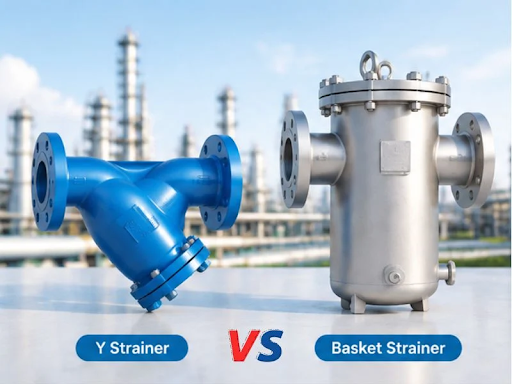
Basket strainer is a mechanical device which consists an open basket mounted inside a casing that needs periodic cleaning to stop restricting the fluid flow. Basket strainer’s key components include a perforated or mesh basket and a vessel. The basket collects the particulate matter as the fluid flows through the strainer vessel.
Basket strainers are generally preferred in applications with high suspended solids as they have a larger screening area.
What Is a Y-Type Strainer?
Y-type strainer consists a cylindrical or conical screen secured in the Y-shaped body. The fluid is forced to pass through the screen as it travels through the body of the strainer. Retained solids are trapped on the screen in one of its branches. The filtered flow is then allowed to pass through the opposite branch.
Y-type strainer is applicable to almost all industries with steam, water, oil, gas, and process lines owing it its compact size and economic design.
Y type strainer’s key components include a primary body with Y-type shape, a screen, and drain plug. A reliable Y type strainer manufacturer should be able to provide quality and accuracy in producing screens, bodies, and screen-body connections.
Basket Strainer vs Y-Type Strainer: The Comparison
The main difference is the size of screening area and means of waste removal. Thus, the flow velocity in basket strainers should produce greater capacity than Y-strainers. Moreover, Y type strainer’s screening is significantly smaller than that of the basket strainer.
Thus, the former is recommended for heavy-duty operations. Due to the larger area, suspended matter will reach the filtering surface with lower intensity. For Y-type strainers, however, an increase in the pressure drop across the strainer is expected.
Another difference between the Y strainers and basket strainers is that to remove solids retained on the screen and to clean the strainer, one may need to loosen the cap on the Y-type strainer. In contrast a simple basket-type strainer has a cap that allows an operator to easily remove any solids from the filtering surface, clean it, and inspect it, if needed. A blow down arrangement is sometimes provided for ease of cleaning of the Y-type strainer.
Flow Direction and Pressure Drop
A pressure drop across the strainer is an important issue in practical applications because high-pressure losses reduce the efficiency of the technological process.
A greater pressure drop is expected for Y strainer since the flow area can be restricted by the retained particulate matter on the screening surface.
On the one hand, basket strainer provides sufficient screening area for large flows and thus, pressure losses are lower; the process efficiency and output is enhanced. On the other hand, the screening area of Y strainer is smaller, so it cannot withstand high flows. Nevertheless, a properly designed Y-type strainer with an increased screening area is able to compensate for this deficiency.
In both cases, the flow rate, pressure of the fluid, and the size of particulate matter should be taken into consideration when selecting the appropriate size of the strainer.
Installation Considerations
In choosing the type of strainer to use, one should pay attention to the site availability. Basket strainers require a certain place above the strainer for removing and inserting it back. Thus, the Y-type strainer can provide space-saving and easy installation due to its compact size.
However, the orientation of the strainer body is important, as the screen pocket must be placed at the lowest point during installation for liquids.
Applications and Area of Use
The following list presents the area of application of each of the strainer types. Common applications for basket strainer:
- Liquid system with a high level of suspended solids.
- Protection of the suction and discharge sides of pumps.
- Cooling and process water systems.
- Frequent cleaning and inspection of the basket.
Common applications for the Y-type strainer:
- Protect the steam, gas, water, and oil lines from impurities.
- Protection of various equipment from contamination in the process industry.
- Compact size allows reducing the area of installation.
- For economical and simple filtration.
Materials and Process Environments
Materials for constructing the strainer’s body and screening also play a crucial role in the performance. Basket strainer and Y-type strainer may have various configurations made of different materials, including carbon steel, stainless steel, cast iron, ductile iron, bronze, and other metals and alloys.
The thickness and size of the mesh of the screen determine the size of particulates that can be retained on the screening surface. A coarse mesh strainer will retain large particles but let small particles pass.
Which Strainer Is Better?
A basket strainer is generally preferred in high flow rate environments, heavy or dense screening tasks, and when routine maintenance and cleansing activities are required. Y-type strainers, meanwhile, are most productive in confined spaces, with lower flow rates, and where less intense screening is necessary for a particular application.
Consider the following factors when choosing between a basket versus a Y-type strainer for your process:
- The liquid’s type/consistency, temperature, and working pressure.
- The amount of contaminants flowing through the system and their potential size.
- The degree of screening/clogging prevention that your process requires.
- The fluid’s flow rate and pressure drop requirements of the pipeline.
- The maintenance accessibility clearance available for the equipment.
- The system’s normal or expected cleansing frequency.
- The proposed installation and orientation profile for the strainer.
- Material considerations for construction and service lifetime.
The Importance of a Manufacturer
Screening or straining equipment may be compromised by imprecise production techniques, resulting in leakage, reduced operational efficiency, decreased lifespan of the screening tool, and irregular screening/clogging prevention capabilities.
A trustworthy Y-type strainer manufacturer should be able to advise on their products’ operational limits, including recommended pressure limits, maximum/minimum temperature ranges, screening tool arrangement and configuration, and other relevant information. The same considerations should be made for a basket strainer manufacturer.
The Bottom Line on Strainer Types
At a fundamental level, both the basket and the Y-type strainer fulfill the same basic functions. The two types of tools find themselves in a competitive relationship, which is to say that the selection of one precludes the selection of the other. Basket strainers, however, possess certain advantages in terms of flow rate, solid matter content, and cleansing accessibility. Meanwhile, the Y-type strainer manufacturer has been optimized to perform a similar function while taking up much less space.

