I have been learning about AI structure for a while now. As AI writing tools continue to evolve, anyone can generate content in minutes. While this has made content creation more efficient, it has also contributed to a surge in low-quality and inaccurate information.
AI detectors use language models to scan text for predictable patterns typical of AI-generated content. Professional article writing services provide authentic, reliable content free of plagiarism. The problem starts when, rather than checking actual origin, AI detectors evaluate phrasing and sentence structure—flagging content whenever it closely mimics these statistical patterns.
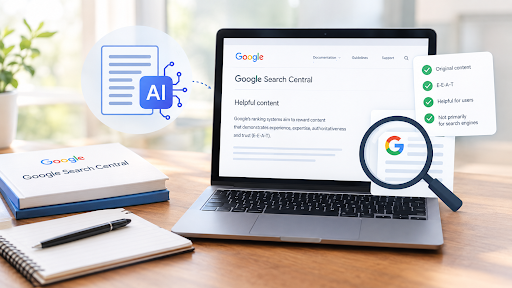
Google prioritizes helpful, original, and people-first content that demonstrates quality, relevance, and trustworthiness. This means a high AI detection score does not specifically determine how well your content will rank in search results. Let’s take a closer look at what all of this means.
Table of Contents
Why Is AI Content Detection Not the Same as Google’s Ranking System ?
AI detectors mostly estimate how the content was written rather than its quality. Therefore, AI detection tools are not always accurate. That’s why AI detection tools should not be fully relied upon.
Google identifies whether the writeup provides people-first content or not. Moreover, Google’s systems assess whether the content answers the user’s query, demonstrates expertise, and provides genuine value.
Unlike AI content detection, Google ranks content even if some parts of it remain AI-generated. A clear structure, adherence to the E-E-A-T principles, and good flow of language help your website gain online visibility.
Analysing Google’s Algorithms
Google’s algorithms consider a wide range of ranking signals. These include originality, usefulness, page experience, and enhanced content quality. Moreover, accurate information and clear structure can elevate your page rankings.
Google does not penalize content simply because it was created with AI. However, content that is mass-produced, inaccurate, copied, or created solely to manipulate search rankings may struggle to perform well. The same standards apply to human-written content that lacks originality or fails to meet users’ needs.
Google’s Take on AI-Generated Content
Google does not blindly dismiss cut-and-paste AI-generated content. Rather, it focuses on E-E-A-T principles. By understanding these core values, you can create content that meets the Google quality bar.
The E-E-A-T (Experience, Expertise, Authoritativeness, and Trustworthiness) framework consists of:
- Experience refers to using meaningful insights and real-life experience, making the content interesting and readable.
- Expertise means that the content has been written by someone who has adequate knowledge of the topic they are writing on. Content creation companies in India provide well-researched and informative blogs that rank well too.
- Authoritativeness refers to the reputation and credibility of the author, website, or brand within a specific industry. Building backlinks, showcasing author expertise, and providing correct citations can increase your online visibility.
- Trustworthiness is informed by experience, expertise, and authoritativeness, but it’s also about increasing user experience and correcting errors. Renowned content writing companies in Kolkata, India, provide desired ranking results via their flawless writing. Moreover, they ensure that the site has HTTPS and clear information for maintaining a structured website, along with correct writing patterns.
Explore the Real Ranking Factors
AI is not just a tool. It plays a vital role in how Search engines understand and rank information. Listed below are a few factors that help in proper ranking.
- The content should be easily readable and should help people understand topic concepts. Many affordable article writing services in Kolkata, provide scalable, human-written content to back up your website efficiently.
- Google generally rewards originality and relevancy. If your content is refined and meets the audience’s needs, then your writeup is ready for publishing. Provide value that readers cannot find elsewhere.
- AI cannot replace human knowledge and creativity. It can only use existing data and build information. Readers engage with content that showcases real-world experience rather than copy-pasting generic AI-generated content.
- Write content that readers can rely on. Organize the content with headlines, bullet points, and separate paragraphs for a clear structure and better understanding.
- A well-structured page, which is fact-checked and does not have outdated information, builds trust among the audience and aligns with
Google delivers a positive user experience. Reputable agencies like Content Freelancing follow a human-led content creation process, using AI to streamline workflows while maintaining uniqueness, originality, and a consistent brand voice.
AI Content Vs Google’s Reality
The table below separates common misconceptions about AI-generated content from what Google officially states about content quality and rankings.
| Myth | Reality |
| Google rejects AI-generated content | Google evaluates based on E-E-A-T |
| AI detectors can accurately identify AI-written texts. | AI detectors estimate writing patterns and can produce false interpretations. |
| AI can replace human writers | It is best used as assistance |
| Passing an AI detector improves Google rankings. | Content quality is what matters. |
Mistakes That Don’t Align with Google’s Guidelines
Google’s ranking systems are designed to reward content that is helpful, reliable, and created for people. Whether content is written by AI or a human, the following practices can reduce its value and search visibility.
- Publishing Content Without Human Reviews
To use AI tools for gathering information is acceptable. But to absolutely and blindly copy AI-generated content will not serve good rankings. Unclear messaging or generic information reduces content quality. Google values content that demonstrates expertise and provides genuine value to readers. Reviewing and refining AI-assisted content helps improve its quality, accuracy, and relevance.
-
Ignoring E-E-A-T Principles
Google encourages content that demonstrates Experience, Expertise, Authoritativeness, and Trustworthiness (E-E-A-T). Content that lacks credible sources or accurate information may appear less trustworthy. Google discards content that is vague and generic without any real-life example citations. Adding expert opinions and providing references polishes the content.
According to Google Search Central, AI can be a valuable tool for brainstorming, research, or drafting, but it should not replace human judgment. Human-written content is always more authentic, gives an immersive experience, and resonates with the readers. This approach not only improves content quality but also aligns with Google’s people-first philosophy for search.
Final Takeaway
AI is changing the way we create content, but it is not a shortcut to better search rankings. AI-generated content alone can never yield good ranking results. Google’s focus has always been on delivering helpful, accurate, and trustworthy information. The winning strategy is to treat AI as a writing assistant rather than a replacement for critical thinking. By prioritizing quality, E-E-A-T, and understanding audience needs, you can create content that earns reader trust and delivers long-term SEO success.
FAQ
- Does Google penalize AI-generated content?
Google does not penalize or reject AI content. Since they rely on probability rather than actual authorship, they can produce false positives and false negatives, making them imperfect indicators. Instead, they focus on the writing structure and the content quality.
- Can AI content detectors accurately identify AI-written text?
AI content detectors cannot accurately determine whether content is AI-generated or not. They rely on probability rather than actual authorship. Thus, analyzing a false approach to human-written content.
- How can one use AI tools without affecting SEO rankings?
Review every piece for accuracy, add original insights and examples, fact-check claims, and edit the content to match your brand voice. Agencies like Content Freelancing ensure your content remains valuable, trustworthy, and aligned with Google’s people-first approach.

