
Introduction
On the speed dial of a mixer in a small paste plant, there’s a strip of red tape. Next to it, a yellow sticky note in Gujarati. Roughly translated: don’t go past the tape; this is Raju bhai’s setting.
Nobody can say why Raju bhai picked that spot on the dial. He left two years ago. The tape stayed, and so did the rule, because the one time a new operator ignored it, a full batch of hazelnut paste came out gritty and went into the bin.
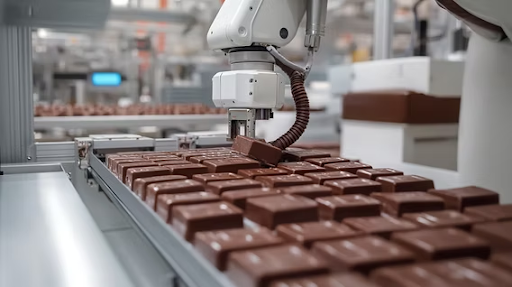
Walk through enough factories, and you find these everywhere. Tape, chalk marks, notes, a number scrawled on a wall by the door. What technology does in a chocolate plant has very little to do with robots, whatever the press photos suggest. It swaps the sticky note for a system that knows what the setting was, when it changed, and who changed it. So when you’re sizing up a Chocolate Pastes and Dips Supplier, one fair question is how many sticky notes are still running the place
Table of Contents
What Actually Gets Measured
Open a tub of paste and you’re mostly looking at very small bits of sugar, cocoa and milk solids sitting in fat. The size of those bits matters more than you’d expect. Too big and the paste feels sandy, and customers say “it’s not smooth” without being able to say why. Refiners and ball mills break the solids down, and better plants check the result with a micrometer or a laser particle analyser. Twenty to thirty microns is the range people usually quote for smooth. It moves a bit depending on what you’re making.
Thickness gets a number now. A viscometer shows how a batch flows, and a few plants read it on the line itself, while the paste is still going through pipes. A batch that’s drifting gets caught early. The old ladle test still works for the man holding the ladle, but his Tuesday night and somebody else’s Friday morning can’t be compared.
For nut pastes, the roast is everything. Hazelnuts pushed a few degrees too far taste flat and slightly bitter, and nothing downstream fixes that. A roaster running a set temperature curve gives the same result day after day. A person on hour eleven of a double shift doesn’t.
Moisture is easy to forget. A bit of stray water wrecks texture and shortens shelf life, so careful plants test for it as routine instead of when something smells off. At the far end, machine filling and date-coding get rid of the small errors: tubs a touch underweight, lids that don’t quite seat, expiry dates that need a magnifying glass.
The Same Job, Done Differently
| Stage | Before | Now | What You’d Notice as a Buyer |
| Weighing | Scoops, bench scale | Automated dosing | Same taste in March as in June |
| Grinding | Rubbed between fingers | Particle size measured | No grit |
| Flow | Ladle and instinct | Viscometer | Dip pours like the sample did |
| Heating | Someone watching a dial | Controlled, with a record | Fewer scorched or split tubs |
| Packing | Mostly by hand | Machine fill, printed dates | Weights match, lids seal |
| Checks | A few spoonfuls | Lab tests, metal detection, kept samples | Fewer surprises |
| Records | Registers, memory | Batch codes linked to logs | Complaints can be traced |
| Delivery | Truck, fingers crossed | Temperature loggers | Proof if it arrives soft |
The Turn: More Screens Don’t Mean Better Chocolate
The tidy conclusion would be that more technology equals a better supplier. I don’t buy it.
A viscometer nobody has calibrated gives confident, precise and wrong readings. Plenty of factory walls carry dashboards full of green lights that nobody has checked in months. Sensors drift. Probes get coated in fat. A number is worth something only when a human looks at it and does something about it.
And no instrument can taste. A plant can run the finest equipment on the market and still feed it cheap fat, old nuts and ordinary cocoa, and the machines will report faithfully that every batch is the same mediocre product. Consistency is only worth having if the recipe was worth repeating.
I’ve come to trust some small, plain-looking units more than shiny ones. One careful person who watches every batch and won’t ship what she’s unsure about will often beat a gleaming facility with a glossy brochure and no way to trace a complaint. Stainless steel photographs well. That’s about all it proves.
Language is another warning sign. “State-of-the-art,” “world-class,” “fully automated.” Printing those costs a few paise. Ask which stage is automated, what gets measured, how often, and what happens when a reading comes back wrong. Well-run plants like the question. The rest start talking about the size of the building.
Raju bhai’s tape, funnily enough, wasn’t stupid. It held real knowledge. The better plants kept that knowledge and moved it somewhere safer than a sticky note.
What You Can Check Yourself
Technology only matters to a buyer if it leaves evidence behind. So look for the evidence.
Batch codes first. Every tub should carry one, and the supplier should be able to tell you which date, which shift and which lots of ingredients went into it. That’s what lets a complaint be sorted out in a day instead of a month.
Then test results. A proper supplier can give you a specification sheet showing ranges for thickness, moisture and shelf life, and often a certificate of analysis for the batch you’re getting. If the answer is a warm promise about quality, you’ve learned something.
Look at the tub too. Does the weight match the label? Does the lid seal cleanly? Can you read the manufacturing and expiry dates without squinting? Smudged dates and uneven seals usually mean nobody is watching the packing line.
Then the journey. An Indian summer is hard on chocolate and the monsoon is worse. More suppliers now put temperature loggers in shipments, and even a cheap one gives you proof when a delivery turns up soft.
The older checks haven’t gone away: a valid FSSAI licence number on the label and invoice, a complete ingredient list, and a real sample from a production batch, held at working temperature for four hours, reheated twice, then compared against a second batch a month later.
Questions worth asking before you sign anything:
- What do you measure on every batch, and what range is acceptable?
- If I report a problem, how do you trace it?
- Which steps are automated, and which are still done by hand?
- How is temperature monitored in transit?
- Can I see a specification sheet and a recent test result?
Pay attention to how quickly and how plainly the answers come. And start small, with one modest first order, so you see how delivery, paperwork and product behave before you commit.
Where Choconutri Fits
Choconutri supplies chocolate products to businesses as well as individual buyers, and it should face the same checks as every other name on your list. Look through the range at choconutri.com, ask how each product is made and tested, request a trial on your own equipment and compare the results with the rest. A brand that trusts its process shouldn’t mind the questions.
Conclusion
Technology is changing how chocolate pastes and dips are made, and buyers feel it in practical ways. Instruments now measure what experienced hands used to judge: particle size, thickness, moisture, temperature. Automated dosing and filling keep recipes and weights steady. Digital records make batches traceable, and loggers show how a shipment travelled.
None of this guarantees good chocolate. Instruments need calibrating, machines need good ingredients, and numbers mean nothing if nobody acts on them. A modest plant with a careful process can beat an impressive one that never checks its own work. What counts is evidence you can see for yourself: batch codes, test figures, specification sheets, readable dates and straight answers about what’s automated and what isn’t.
Choose a Chocolate Pastes and Dips Supplier on that evidence, test real samples twice and start with a small order. Do that, and the knowledge that used to live on a sticky note beside a mixer ends up somewhere it can’t walk out of the door.