
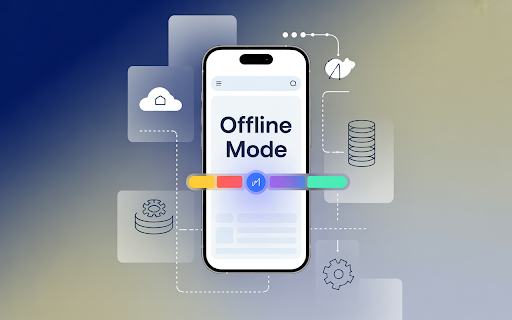
In the modern digital world, mobile applications are essential devices that are used by both businesses and consumers. Nevertheless, a problem of connectivity has continued to exist, especially in areas with unstable internet connectivity. This is the area where the offline-first mobile applications shine, and can provide smooth user experiences with or without network connectivity. To companies interested in experience in this sphere, any collaboration with an application development company in Dubai may be the only difference between an effective application and a user-friendly one.
Table of Contents
The concept of the Offline-First Aproach
The offline-first approach gives less emphasis on the internet connectivity as something that can be enhanced, but is not a necessity. This will be effective in ensuring that users are able to use important features and content even when they are offline, with the data automatically syncing when they go online again. This philosophy in design has grown very significant with the mobile users anticipating constant access to their applications, be it when they are on their way to work, commuting through tunnels, traveling abroad, or working in a region that is poorly covered by mobile networks.
The Major Strategies of the Offline-First Apps
Implementation of local Data Storage
The implementation of the offline-first approach is based on the local data storage strategy. Contemporary mobile platforms have other alternatives such as SQLite databases, IndexedDB, and local storage APIs. The developers have to consider the type of storage mechanism that fits best in the data structure and access characteristics of their application. SQLite offers the most powerful solution with the best query capability for complex applications that need management of relational data. On the other hand, document-based storage systems are effective with apps that have dynamic data schemas.
Data Synchronisation Architecture
The most difficult part of offline-first development is, perhaps, effective data synchronization implementation. An effective synchronization system should be able to resolve conflicts in case the same information has been edited locally and on the server. Application development experts in Dubai suggest the use of timestamp-based versioning or operational transformation algorithms in arbitrating the conflicts in an intelligent manner. The synchronization process must run in the background, which will consume less battery but maintain the consistency of data between devices.
Strategies of Caching to improve performance
The concept of strategic caching is important to offline-first applications. The developers need to employ multi-layered caching policies that give priority to the most frequently used information and resources that are crucial. Service workers, especially in progressive web apps, are able to intercept network traffic and provide a response to a request, either cached in offline mode. Lazy loading and progressive enhancement of images and assets are also used to optimize image and asset loading, causing the images to be more performance-friendly and consume less storage.
Best Practices of Implementation
Creating Friendlier Offline Experiences
The offline-first applications are still user-driven. The status of the connectivity of the app must be clearly indicated with no intrusion by the use of visual cues. The discrepancy between the offline functionality and the online capabilities should be accompanied by assistance notifications, in which the available features are explained to the user. Skeleton screens, loading states, and optimistic updates to the UI can be used to ensure that perceived performance remains high even when network requests are in progress.
Installing Strong Error Processing
Complete error management is the difference between professional and amateur applications. The developers should be able to expect different scenarios of failure, such as partially connected situations, the expiration of authentication tokens, and the lack of storage capacity. The failed requests can be stored in queue based architecture to be retried in case of improvement in connectivity. The error messages must be clear but non-technical and direct the users to the resolution without frustrating them.
Data Security in the Offline
The offline-first applications cannot compromise security. Any sensitive data stored in the local storage should be encrypted by using security mechanisms that are relevant to the platform. The usage of authentication tokens needs to be managed to ensure that the level of security and ease of use are balanced. A prominent mobile application development firm in the UAE insists on using certificate pinning, storing of keys, and flawless management of the session to secure information of the users even when the devices are off the net.
Quality Assurance and Testing
Offline-first applications need to be well tested. Throttling tools and airplane mode should be used to test different network conditions by developers. Special attention is needed on edge cases like switching networks or providing interrupted synchronization. Test frameworks that are automated can model offline behaviors, as they have constant behavior under varying conditions and devices.
Optimization Methods of Performance
In offline-first apps, performance optimization acquires an additional significance. Developers ought to reduce the time loads take by focusing on the most important resources and code splitting. Background synchronization must be effective in order to conserve battery and prevent unnecessary use of data. Tools of monitoring assist in the detection of bottlenecks of performance and the optimization of resources.
How to Future-Proof Your Application
The mobile environment is ever-changing and technologies and possibilities are introduced on a regular basis. Progressive Web Applications (PWAs) are very good at supporting offline functions and are cross-platform compatible. Recent libraries such as React Native and Flutter offer native offline functionality and reusable code at the same time. Keeping up with the updates of the platform and industry best practices keeps your application competitive and sound.
Conclusion
Developing offline-first mobile applications is a big investment in user experience and application reliability. Designing applications to be highly local, smartly synchronized, and careful of the user interface enables developers to build applications that operate smoothly whether or not there is connectivity. The offline-first approach provides concrete results in terms of user satisfaction and engagement, regardless of the platform it is written on, iOS, Android, or Web.
Those organisations that invest in this way of doing things, especially those that engage an established development team, place themselves in a position to succeed in an increasingly mobile-first world. The practices and deployment considerations discussed here give a good ground upon which to develop outstanding offline-first applications that can satisfy the expectations of the current users. For more information just contact us today!